
RECENT POSTS

LifeBio Voice Research November 08, 2026

LifeBioTALK Poster at GSA 2026 November 02, 2026
LifeBio Memory Phase IIB Grant Awarded September 23, 2025
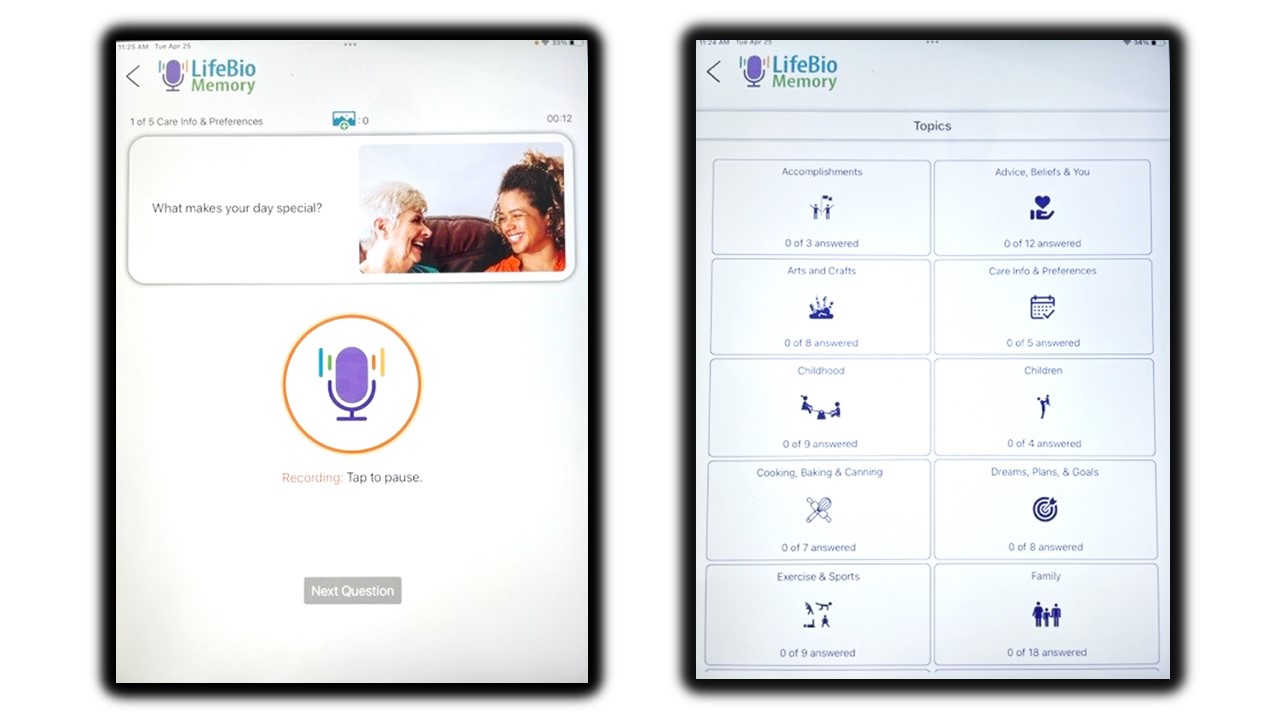
LifeBio Voice Research: Hear What People Are Really Telling You

LifeBio Voice Research: Hear What People Are Really Telling You
Surveys can tell you what people selected. Their voices can tell you why.
LifeBio Voice Research is a HIPAA-compliant platform for collecting, preserving, organizing, and analyzing voice-recorded qualitative feedback from patients, health plan members, study participants, caregivers, and other populations.
Rather than requiring people to type lengthy answers or communicate only through rating scales and checkboxes, LifeBio lets each participant respond to questions in their own voice.
The actual voice recordings become part of the qualitative data.
From Question to Voice to Insight
Organizations create the questions they want participants to answer. Participants record their responses using LifeBio, creating a rich source of qualitative information in their own words.
Authorized researchers and organizational teams can then use the LifeBio dashboard to:
- View recordings by participant
- Listen to the original voice-recorded responses
- Review responses to specific questions
- Analyze qualitative information across participants
- Access automatic summaries of the collected information
- Return to the original recordings whenever deeper analysis is needed
The result is a straightforward workflow:
Ask → Record → Listen → Summarize → Analyze → Act
And because the voice recording is retained, the researcher or organization can go beyond an AI-generated summary and return to the participant's actual response.
For Health Plans: Hear the Member Experience
Health plans invest heavily in understanding member experience, access to care, communication, and service quality. The CAHPS Health Plan Survey, for example, has become a national standard for measuring consumer experiences with health plans, and its results are used to identify strengths and weaknesses and target areas for improvement. [ahrq.gov], [medicaid.gov]
LifeBio can complement structured measurement by helping plans understand the story behind the score.
A member can explain:
Why was it difficult to get care?
What was confusing?
What could the health plan have done differently?
What is getting in the way of managing your health?
Instead of another checkbox, the plan gets the member's voice.
That creates qualitative insight that can support member experience, quality improvement, population health, member engagement, care management, and service improvement.
For Health Care Providers: Understand the Patient Experience
Hospitals, health systems, clinics, home health organizations, and other providers can use LifeBio to collect patients' perspectives on their care.
CMS specifically distinguishes patient experience from simple satisfaction, focusing on what patients experienced in areas such as communication, medication instructions, and coordination of care. [cms.gov]
LifeBio provides a way to go deeper.
A patient can describe what happened in their own words. Quality and patient-experience teams can listen to individual recordings while also using LifeBio's automatic summaries to help understand feedback across larger groups.
Instead of knowing only the score, organizations can begin understanding the reasons behind the score.
For Universities and Research Organizations: Preserve the Original Voice
For university investigators, health-services researchers, clinical researchers, and other evidence-based research teams, LifeBio offers something equally important: direct access to the primary voice data.
Qualitative interviews are particularly useful for understanding individual experiences and perspectives, and audio recording has long been used to create records for subsequent transcription and analysis.
LifeBio brings that process into a centralized platform.
Researchers can collect voice responses from individual study participants, organize those recordings within a study, listen to the original responses, use automatic summaries, and conduct their own qualitative analysis.
LifeBio doesn't replace the researcher. It gives the researcher better access to the voice behind the data.
One Platform. Thousands of Voices.
The opportunity for LifeBio Voice Research isn't simply better transcription.
It's voice-based qualitative data collection at scale.
A health plan may want to understand why members struggle to access care.
A health system may want to know what patients really experienced after discharge.
A university investigator may need voice-recorded responses from hundreds of study participants. They may also be investigating digital biomarkers for various health conditions.
All three have essentially the same problem:
They need an easier way to ask people questions, capture what they really say, preserve those responses, and turn hundreds or thousands of voices into information they can understand and use.
That is where LifeBio Voice Research fits.
Ask the question. Capture the voice. Understand the experience.
LifeBio Voice Research
Voice-based qualitative insight at scale.
LifeBio Voice Research
The human voice, transformed into research insight.
Would you like a demo? Need a proposal for current or future research? Email partnerships@lifebio.com